

Hey! Look over here!
Never before has our attention been so fiercely fought-over, which unironically reveals its value. And nowhere do we give attention up more thoughtlessly than in the tiniest slices of our lives — in the waiting rooms and elevators, in grocery store lines and drive-throughs, when the urge to look away from the world and down to our phone screens is the strongest. There are many ways to combat this. In one famous anecdote, Kurt Vonnegut insists on walking to the store to buy an envelope instead of, as his wife suggests, ordering a thousand of them to be delivered to their house. He explains the rituals he does on this walk and the people he sees, ending with “…we’re here on Earth to fart around.” And, of course, the computers will do us out of that.
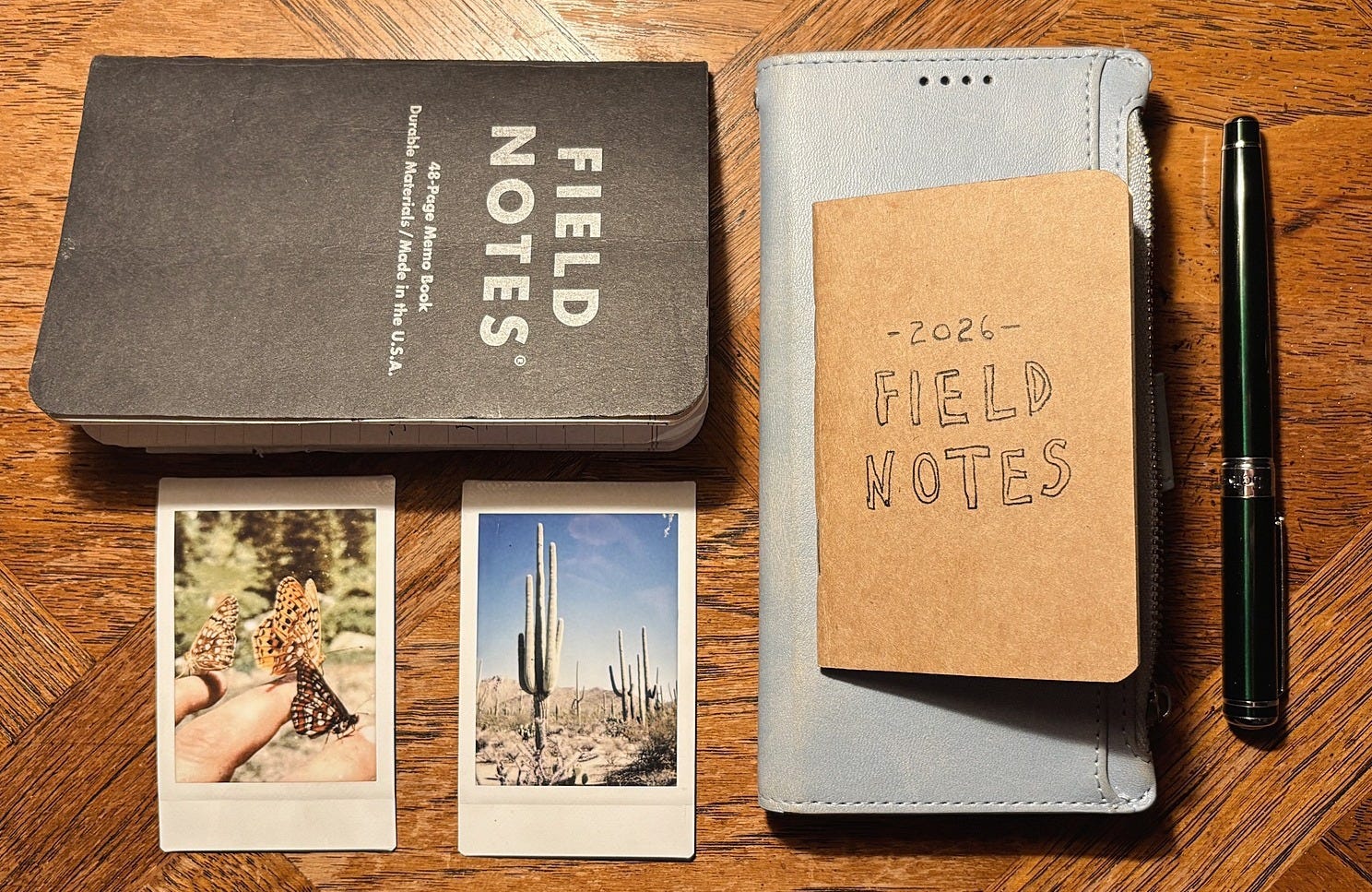
I regularly experience a similar, hard-to-pin-down feeling of losing something vital, so in mid-2024, I bought a tiny notebook titled FIELD NOTES and stuffed it into my purse. On the first page, I transcribed a quote from Annie Dillard: “How you spend your days is… how you spend your life.” I didn’t mean for this quote to forecast, over a year later, my 2026 New Years Resolution: to write down one observation a day, for the whole year.
Classes and Categories -
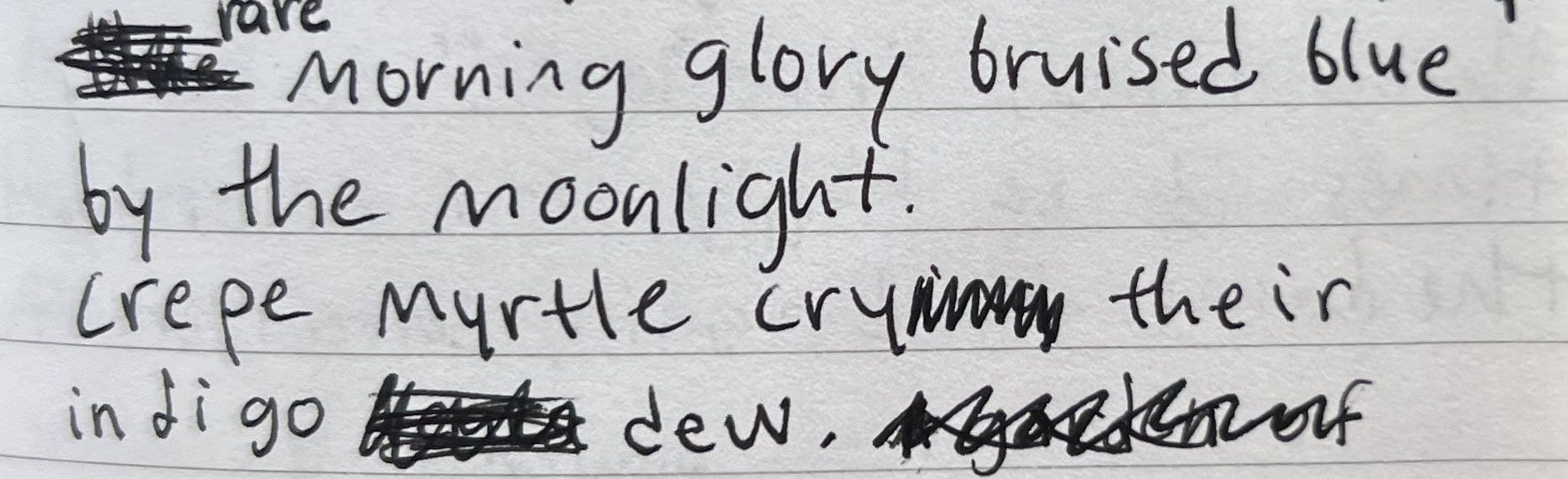
When I first got the notebook in 2024, I intended to pull it out when I was bored at social functions instead of scrolling on my phone. One of my first entries is a disorganized tangle of overwrought sentences I tried to force into some kind of poem.
The entries got a little more interesting after I took the notebook with me to a soccer match I had an obligation to attend. To combat my boredom, I watched the match yes, but I also watched the players, the families, the coaches. I wrote: There’s always that one player on the sidelines, yelling at his teammates as if they can see the game from his perspective. Is he benched so often he’s forgotten you can hear absolutely nothing but the refs whistle when the adrenaline is roaring in your ears? It was a simple (and sassy) observation, but it felt revolutionary. It was more than a description of the scene, it reframed the scene entirely. It is a skill I’m just beginning to recognize, but exists in great writing everywhere.
In an interview with NEWSNIGHT, Donna Tartt likened jotting observations down in her little traveling notebook as the writer’s version of an artist sketching in a sidewalk cafe. “If you need a character, all you have to do is look up,” she said. And Joan Didion wrote in her essay on keeping a notebook, “Some morning when the world seems drained of wonder … On that bankrupt morning I will simply open my notebook and there it will all be, a forgotten account with accumulated interest, paid passage back to the world out there: dialogue overheard in hotels and elevators and at the hat-check counter in Pavillon…”
Looking back at my entries, I’ve discovered the forms my observations fall into, and how each form has distinct benefits. Every entry sits under the umbrella of Might One Day End Up In A Novel. But below that, there are two classes, non-fiction and fiction, for whether the observation is drawn directly from real life, or simply inspired by it. In each class, there are five main categories; Dialogue, Humor, Description, Commentary, and Misc.
Dialogue -
I tend to write down a lot of dialogue — it is what I’m most drawn to recording. One of my favorite lines came from a guest who was visiting the whimsical garden estate I work at. He remarked and I recorded: “A place like this makes you want to live forever.” A lot of my loved ones appear in this category. When Dylan forgets things, he says he didn’t forget, I wrote. He says, “They are just misplaced memories. I have a crack in my brain where they blow out.”
I, like many writers, have warned those around me that uncopyrighted phrases may be stolen and repurposed. But a lot of the dialogue I’ve written in my Field Notes has come unbidden into my mind while staring off into the middle-distance.“The world loves me right now,” one entry reads, and I can’t remember if it was supposed to be funny or poignant, or maybe both. Either way, noting the way real people speak and isolating the impactful lines sharpens my own ability to write compelling dialogue.
Humor -
I also tend to write down the things that make me laugh. Because of this, entire sections of my Field Notes essentially became a love letter to the people I admire most in my life. A wine-drunk night in a hot tub with my best friend postmarked our dark humor.
Lydia: What would we do if one of us was dating an actual psychopath?
Me: I don’t think we’d ever get that far apart in logic.
Lydia: You know what I’d do first?
Me: Poison him?
Lydia: No.
Me: Entrap him in infidelity?
Lydia: Well yes, but not with me, that’s too obvious.
Me: Go for it.
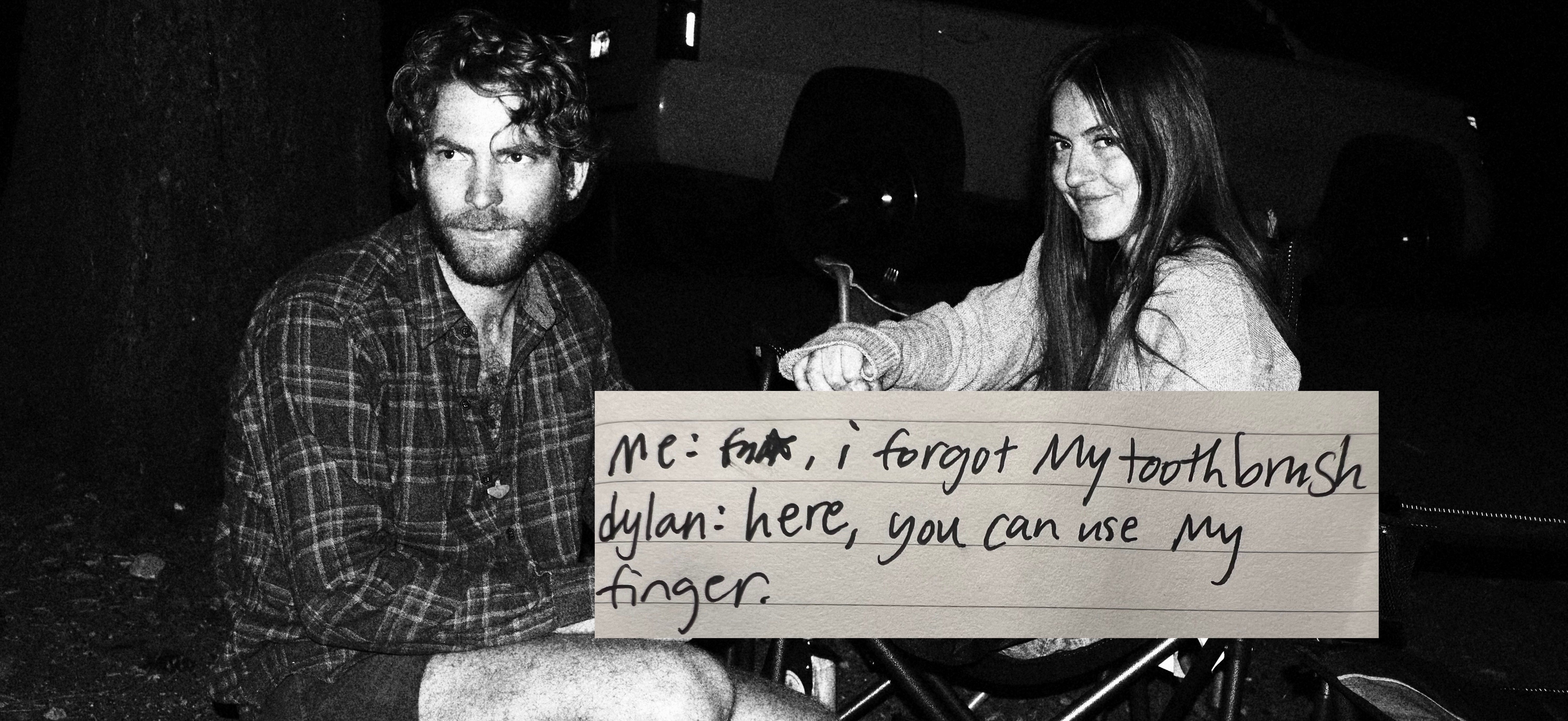
And Dylan (my partner) shows up on almost every page. On one of our many camping trips, I stumbled away from the campfire to scribble.
Description -
I am not great at writing compelling description in my novels. With my Field Notes in hand however, I started noticing the details of craftsmanship and the difference in textures as I searched for something to fill in the lines. White swan fence, I wrote on a walk through San Diego’s Mission Hills neighborhood. Arched, metal necks. And as I sat in a seaside café the next morning: No trace of the sun except for sandy ocean hillsides that glow from its reflections. I put myself in places I want to get better at describing. Blurry sunset, smudged across the sky. Mountains, brushed with light. I wrote during a drive through the desert with the dogs. Jack and Scout, running through the sagebrush and sand.
“They’re gonna get rattlesnook,” Dylan says.
Sometimes the descriptions are childishly simple, little details that could belong in any book. Character who has to crawl in through her trunk because both her cars front doors are broken, I wrote, after overhearing a friend fondly recalling her first vehicle. Some advice I heard once: Look for the stories people repeat.
Commentary -
In my opinion, commentary holds the most advanced form of observation because an added layer of analysis is written in. It takes more time. No surprise I have the least amount of entries in this category, as I am someone who tries not to form opinion too quickly. An example I like more than my grumpy critique of the soccer player is one I wrote during the New Jersey drone freak-out of late 2024. I titled it: My Hot Take on the Drones, and below it wrote: I am pro anything that gets us looking up into the night sky. It doesn’t need to be revolutionary, but it should say something other than what is tangibly happening. Besides behavior and news, commentary can be around cultural issues, moral dilemmas, the state of the world… etc.
At the dog park last summer, I wrote: Scout looks for me in the crowd after she runs in many circles. When she spots me, she is immediately overjoyed. It is a visceral relief, like at any moment she might be abandoned, and when I am still here, when I choose her again, as I do every time, it is no less a miracle. Sometimes the entries are quite personal. Last fall while sitting on the porch with Scout, my hair pulled up in a two-day bun, my reminder went off to write something down. I thought for awhile, then scribbled what felt most true in that moment. Thank god for the days I do not have to be observed.
Misc -
I am in no way saying these strings of thought are good writing (let alone grammatically correct). Only they capture a small brush stroke of reality and my space in the world at any given moment. They are mostly ordinary - attempts to romanticize the mundane. Sometimes all I can say about a day is I enjoyed the warm chai, I wrote last month. They may be random phrases. Black Market Wisdom Teeth removal. Or I will write down words I liked: Behooves, Consolation Prize, Ripe. And lots of memories. Don’t forget [Dylan] grumbling about the Christmas beer [he ordered] and how it wasn’t very festive. “Can I get a candy cane or something?” He said.
In conclusion -
Mary Oliver suggests in her poem Yes! No!, that paying attention is “— our endless and proper work.” This year, I am framing it as an intentional and nurturing practice to keep my radar tuned to the small and (extra)ordinary. I plan to re-read the entries often. (As a side benefit, I’d like to describe these aspects of my days vividly enough to bring me back to them, so I quit losing so many.) You never know what you’ll catch when you’re holding the net out. Today, while sitting in my office to write this essay, I jotted the note: Wind is pushing the trees around today. Shadows dart back and forth across the window pane.
Our brain snags on things every day. Writing them down cements their importance and increases the likelihood we’ll remember them. Phones can work in a pinch, but studies strongly suggest handwriting better aids in preserving memory. Whether by the act of lingering on the sentiment a second longer, or by being more connected to the shape of each letter, the exercise is undeniably effective. It sharpens the way we look at the world and increases our ability to call back on details during conversation or in creation.
Ultimately, I am just another person asking for everyone to put their phones down and look up. But I am asking for more than that too. Engage in socially acceptable snooping and watch strangers in line at the grocery store. Who looks happy? Who looks angry? What are they buying? Look for meaning in peoples actions the way you did with your first crush. Assign generous interpretations. Sift through the world as though it is hiding great treasure from you.
It probably is.
Rattlesnook is my new favorite word