


Somewhere right now a writer is pasting her third chapter into a chatbot and asking for help. Most of us shake our heads, believing a machine can’t give better advice than a human can. And while it’s true I have no interest in artists who think technology is the better artistic collaborator, I do have sympathy for the writer who is looking for community and finds the chatbot to be the only one awake when the draft is done at 2 am. Alone at a screen, she is doing what Hemingway did on a marble-topped table at the rue Delambre: looking for someone to hold their work up to. He had Gertrude Stein and F. Scott Fitzgerald and a half dozen other intellectuals and artists at the seats across from him. She has a probability engine.
The chatbot writer goes looking for the cure and our culture hands her the myth: read enough craft books and interviews and you will continually be advised what you really need is some kind of metaphorical Paris like the one Hemingway wrote about in his final memoir, A Moveable Feast. Beautiful architecture, cheap wine, and Gertrude Stein deciding you have potential and inviting you back every Saturday for revisions, etc. The reality is Gertrude Stein ran her salon on family money; the rue de Fleurus operation — the Cézanne paintings hung on the wall, the Picasso patronage, the Saturday evenings — all funded by income from the Stein’s San Francisco real estate, (managed by her brother Michael, who invested following the 1906 earthquake).
And a yearly $3,000 allowance from Hadley Richardson’s inheritance allowed Hemingway to quit his job at the Toronto Star and pursue his dreams full-time. $3,000 in 1922 Paris made them comfortable and by 1924 made them rich, because the franc had collapsed and Americans were living like royalty off the exchange rate. (He later left her and their infant son for another woman, but I digress…) The drinks flowed, the marriages consumed themselves more or less on schedule, and the myth of the vagabond writer was born. To be clear, the writers were dedicated and the feedback mechanisms worked, but it was purchased off the backs of abandoned families, failing livers, and struggling post-war economies.
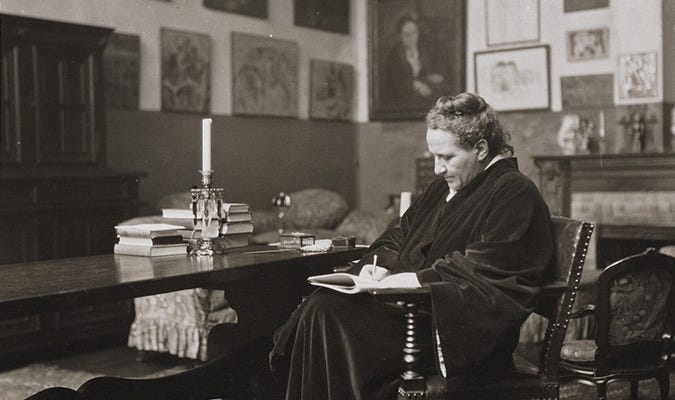
Unfortunately now, “find a writing group” lands as the over-the-counter version of a drug that was discontinued a century ago. A necessity of the successful and fantasy for the uninitiated, this instruction assumes an infrastructure that isn’t here for most people (short of buying one with an MFA that isn’t guaranteed to pay you back). In reality most artists loot the Internet for community, while trying to protect the last frontier of unplumbed real estate: our interior architecture. Or what this Substack writer Abi Awomosu calls “faculty of imagination, of perception…”^1 The cost of this scavenging is self-depletion; we pay for each find with the attention we should be reserving for the work. To combat this we look for clues hidden in the texts of the successful.
One thing Hemingway gets right in his memoir is the “moveable” part of the feast. It can happen anywhere, in any home, and one answer to finding it lies in the hands of the same technology I criticized in the beginning. But we must be savvy and fight against the Internets seductive convenience and crawl to the other end instead. We must utilize its reach to find the people who understand our insular obsession with the particular arrangement of words. The people who can spend days sharing drafts and discussing books, the people who are ready to break through the screen and create their own Paris. If you are reading this, you have found one such person.
A PROPOSAL FOR REBUILDING PARIS, WITHOUT THE TRUST FUND
The immediate goals are concrete. Gather in a place with the highest potential for beauty. A person writes differently under fourteen-foot ceilings than under fluorescent panels. The room you choose should be built as an extension of your art, an argument about what your work could be. Here you will find those partners who will create with you for decades and whose critiques draw blood cleanly, not the strangers who’ll skim one draft. Make your commitments out loud, at a table, to people who will be at the same table tomorrow. A deadline spoken to another person’s face has a weight no calendar notification will ever reproduce.
The longer goals are less polite. Learn to have your ideas dismantled at dinner and come back down to breakfast anyway. Convictions should be stress-tested until only the load-bearing ones remain. And learn to finish, not through discipline, which is private and therefore negotiable, but through witness, which is not.
Which leads me to my next point:
IN DEFENSE OF PERFORMATIVE CREATIVITY, PROVIDED THERE ARE WITNESSES
It has come to my attention that another major benefit to creative gatherings is their inherent ability to capitalize on our performative nature. Instead of grabbing a monster energy drink from the fridge and staying in pajamas to write, we brew coffee in a green ceramic pot and braid our hair with flowers because the surrounding folk give us reason to. The aesthetics posted all over online and which feel difficult to maintain on a daily basis, are easier to engage in when done together. It works this way for writing too. When everyone is there to witness you being a “writer” you cannot pull out your phone mid-session to watch the fifth tiktok video of a dog chasing its tail. That would be embarrassing and rightly so. The creative gathering hands back the visibility in the way that matters. Posting online is a curated visibility and an easily forgotten one (you only need to be a “writer” for 30 seconds). When you are locked in a room together, pens in hands, surrounded by the books you wish to emulate, it becomes a lot harder to fake.
In my utopia there are long stretches of time where phones are left facedown and vending machines dispense mass-market paperbacks or zines from previous gatherings. Arguments about novels are mandatory at dinner. Each person brings offerings to share with the express intent to leave it behind, whether it is a piece of decor for the room, an artistic practice, craft supplies or a piece of their art, a book, an openness to receive or provide feedback, etc. Meals are curated, and that means real plates, real silverware, long banquet halls, family style feasts, and no plastic. Tea and wine abound instead of hard liquor. Beyond that, it is just you and your instrument, and all the right people to perform for.
MY SOMEDAY OFFERING
I manage a gothic estate that should be full of artists by now. The property has the history for it (hand-built by the original owner) and the architecture for it (inspired by the English countryside). Best of all the beauty here acts as a form of pressure; the gardens refuse your worst sentences in a way your kitchen table never will.
I'm working toward opening the space to creative gatherings, but it must be said that none of this requires an estate. A mansion is no more realistic for most people than 1922 Paris, and I refuse to end an essay about dismantled fantasies by installing a new one! The creative gathering is a mechanism, which can be built at any address that will hold a long table. The bare room might even be better since it takes the shape of whoever and whatever fills it. I.e., this property comes with a history that isn’t yours while your basement comes with nothing. You choose the rituals, the art on the walls, the reading list, the hour the arguments start, etc.

Besides, the artists we mythologize didn’t always have the best rooms either. Stein’s salon was first an apartment and the Dôme was a café that served anyone with two francs. They consecrated ordinary spaces by what they did in them repeatedly (and that doesn’t require a chandelier). The beauty is negotiable but the witnesses are not. So build your own Paris, and if you want to borrow the grandeur while you build, I know a house with the bones for it and the door is not locked.
This is a long but intriguing essay I did not completely finish. In all transparency I do not know much about the author, but I did draw heavily on her concept, hence the attribution.